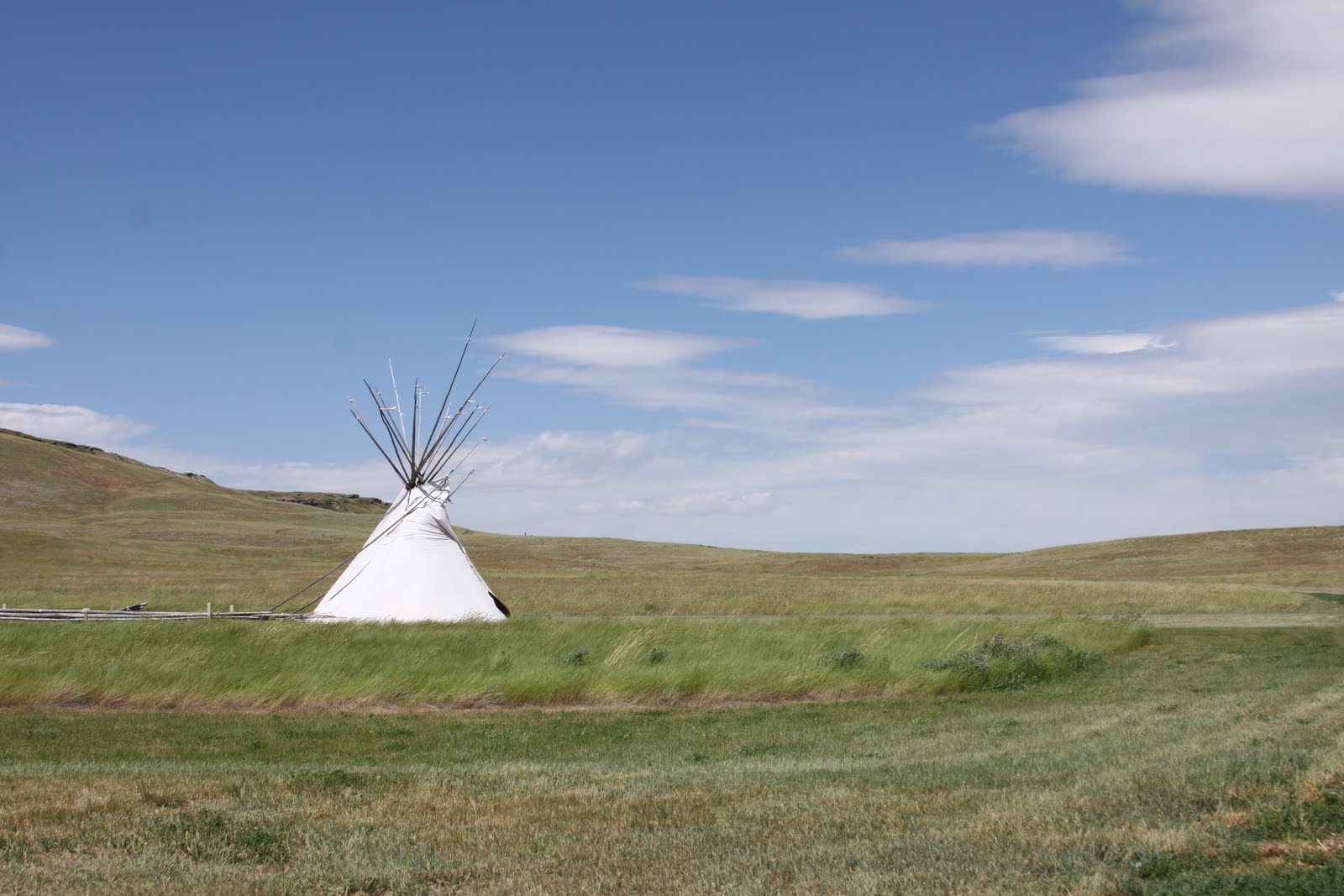
First Peoples Buffalo Jump State Park, formerly known as Ulm Pishkun, is an archaeological site with possibly the largest bison cliff jump in North America. Native peoples used this site for at least two thousand years prior to Lewis and Clark's expedition through Montana. The kill site consists of a mile long sandstone cliff; there are remnants of drive lines on top of the cliff and the remains of millions of 'processed' bison below. The process of tricking the bison was done before 1730 when Plains Indians did not have horses; a successful hunt require the coordinated work of all members of the tribe. The buffalo was sacred to the Plains Indians; the result of the annual kill resulted in the starvation or survival of the tribe.
Tuesday, July 27, 2010
First Peoples Buffalo Jump State Park, formerly known as Ulm Pishkun, is an archaeological site with possibly the largest bison cliff jump in North America. Native peoples used this site for at least two thousand years prior to Lewis and Clark's expedition through Montana. The kill site consists of a mile long sandstone cliff; there are remnants of drive lines on top of the cliff and the remains of millions of 'processed' bison below. The process of tricking the bison was done before 1730 when Plains Indians did not have horses; a successful hunt require the coordinated work of all members of the tribe. The buffalo was sacred to the Plains Indians; the result of the annual kill resulted in the starvation or survival of the tribe.
Tuesday, July 13, 2010
We enjoyed the Charles Russell Art Museum in Great Falls. Among his many art forms, Russell would put art into his letters to friends. This note is thanking friends for ? that he and his wife, Nancy, were given. This place has been one of my favorite stops on the trip.
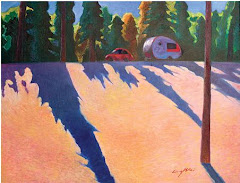
On to Helena, the capital of Montana. We arrived late in the afternoon and parked the tab at the curb in front of the beautiful capital bldg., and had burritos in the T@B. Not one car passed on the street as we had dinner. The red flowers are arranged to say, "Montana, 2010".
Ashley prepares to dive into the Giant Springs; from a fracture in the Earth's limestone, water flows upward at a force of 300 pounds per square inch, discharging 156 million gallons per day. William Clark discovered this June 18th, 1805, "we proceeded on...to the largest fountain or Spring I ever Saw. and doubt if it is not the largest in America Known, this water boils up from under th rocks near the edge of the river and falls imediately into the river 8 feet and keeps it Colour for 1/2 a mile which is emencely Clear and of a bluish Cast..." (sic).
We enjoyed the astonishing Great Falls at high water flow as described by Meriwether Lewis on June 14th, 1805 "...hearing a tremendious roaring above me I continued my rout across the point of a hill a few hundred yards further and was again presented by one of the most beautifull objects in nature, a cascade of about fifty feet perpendicular streching at right-angles across the river from side to side to the distance of at least a quarter of a mile...the water decends in one even and uninterupted sheet to the bottom wher dashing against the rocky bottom rises into foaming billows of great hight and rappidly glides away. hising flashing and sparkling as it departs the sprey rises from one extremity to the other..."(sic).
Ashley arrived in Great Falls July 11, and we went over to the Lewis & Clark Interpretive Center to help the Corps of Discovery portage the dugout canoes around the 18 mile stretch of waterfalls on the river. Ashley's strong muscles required only a light touch, and my pulling on the rope hardly made a speck of difference.
Tuesday, July 6, 2010
4th of July parade in Arnegarde, North Dakota; The Missouri-Yellowstone Confluence; Fort Buford; Fort Union Trading Post National Historic Site; Fort Peck Dinosaur Bones
My T@B was invited to be in the parade for the 4th with the energetic/creative WIN RV group. We had a fine time--more photos on this later.
The Corps of Discovery first saw confluence of these two great rivers April 5,1805. Lewis wrote, "I ascended the hills from whence I had a most pleasing view of the country...The whole face of the country was covered with herds of buffalo,elk, and antelopes...so gentle that we pass near them while feeding without appearing to excite any alarm among them." That was what I experienced driving into the Roosevelt
campground--lots of bison who took no notice of me!
The historian in my photo at Fort Union explained how it was the "Walmart" of the west, owned by businessman John Jacob Astor who made a fortune knowing how to do business with the indian tribes. I was served hot coffee from a pail over the fire (very tasty) and looked over the trade goods in his shop; one item was a fancy officer jacket which cost 18 buffalo robes!
On down Hwy. across Montana, I stopped at the Fort Peck Dam Interpretive Center where fabulous dinosaur skeletons were reconstructed. I am in the Havre Library as I write this on a rainy day. Thank you for your comments & keeping in touch on my travels. Credit to Diana Tolerico for her photo of me on the hike.
Wednesday, June 30, 2010
June 26-27 Pierre, South Dakota
June 28 Fort Lincoln, Mandan, North Dakota,
Fort Mandan: The Expedition's first winter
June 29 Theodore Roosevelt National Park, N.D.
The photo of Lewis & Clark is at Fort Mandan,N.D., a reproduction because the original no longer exists. The Fort was built a few miles from Mandan and Hidatsa villages who were friendly and provided corn in exchange for axes that were made in the Fort by the blacksmith. Because of extensive Indian trading, one of those axes arrived in the Columbia River Gorge area before Lewis & Clark got there the following spring! There is a great interpretive center near Washburn, N.D. where I tried on a buffalo skin 'coat'. It was so heavy it was difficult to walk around in it. Also there was a cradle board with a doll baby that I tried to lift but it was very heavy. This would have been how Sacajawea carried Pomp (Jean Baptist Charbonneau) around on her back; she had to be a strong woman.
The photo of the keel boat is a reproduction of the main vessel that carried the Expedition's tons of goods upriver to Fort Mandan and then returned downstream in 1805 to carry the nature specimens and journals and notes up to that time to President Jefferson. This reproduction is on the waterfront in Bismarck, N.D.
Just the work of traveling even with all the improved technology that I have 200 years later, takes a toll. I find that everything must have a place and be returned to that place and be clean and in repair. Much of the Expedition's time must have been spent on this. Also, the journaling which was to take place every evening, was another job on the Trail. I find that sitting down and getting settled to write seems practically impossible with every day changing, sometimes arriving late at a camp site thinking more of food & sleep.
The past two nights I've spent in Theodore Roosevelt National Park. The area is beautiful and environmenally pristine. The Park takes pride in it's thriving eco systems and clean air and clear skies. It is a little like Eden staying here. Driving along, buffalo come walking down the road toward me--and take little interest. Buffalo can run 35 mph and turn faster than a horse, so we tourists are cautioned to take it easy around the bison.
Pres. T. Roosevelt came out here as a Harvard graduate, city-bred, asthmatic, skinny and weak. He took to cowboy life, and became a changed man in about 3 years. He claimed that the Dakota Badlands brought him vitality & health. He was an avid reader and writer; always had a book with him. He was great conservationist; he is credited with saving 5 National Parks and many National Forests.
Subscribe to:
Posts (Atom)